
Introduction to Elliptic Curves
Elliptic curves have played an important role in complex analysis since the 18th century and have been a foundational topic in number theory since the 20th century. They are complicated enough to illustrate many deep mathematical phenomena, yet simple enough to allow for explicit computations.
In this course, we will develop the theory of elliptic curves from elementary foundations. One of our main arithmetic goals will be to prove the Mordell–Weil theorem, which states that the rational points on an elliptic curve form a finitely generated abelian group. There will also be room to tailor the specific topics we cover to the interests of the participating students.
The course will be challenging, but it will be well worth the effort for anyone interested in pursuing further studies in number theory, algebraic geometry, or certain areas of complex analysis.
Curves with a group law
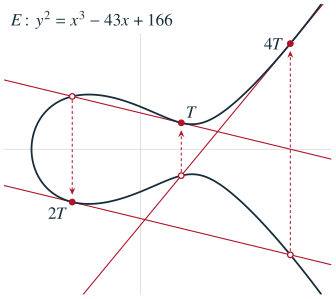
The points on an elliptic curve can be added, and they form a group.
On the curve , double the point three times and you are back where you started: , so has order 7.
Those are all the rational points: , , , and the point at infinity. By Mazur’s theorem, no rational point on an elliptic curve over has finite order larger than 12.
One curve, many fields
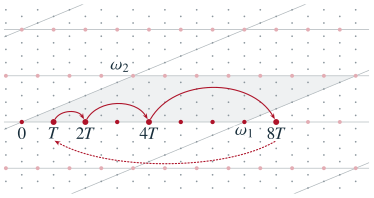
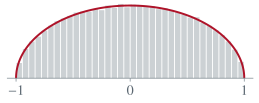
The same equation makes sense over any field, and each choice of field shows a different side of the curve.
What we will cover
Core
- Elliptic curves through Weierstrass models
- The group law, explained through linear equivalence of divisors and the Riemann–Roch theorem
- The Tate module and the Weil pairing
- Isogenies, endomorphism rings, and automorphism groups
- The formal group of an elliptic curve
- Elliptic curves over finite fields, over , and over local fields
- Elliptic curves over global fields: the Mordell–Weil theorem
Further topics, chosen with the class
- Moduli of elliptic curves
- Elliptic surfaces: reduction types and Kodaira symbols
- Computing Mordell–Weil groups
- -series of elliptic curves and the Birch and Swinnerton-Dyer conjecture
- Modularity of elliptic curves over (Wiles, Taylor–Wiles, Breuil–Conrad–Diamond–Taylor)
The precise content of the course can be tuned to the needs and interests of the students.
Who should take it
Graduate students interested in number theory, algebraic geometry, or arithmetic geometry. The course assumes:
- undergraduate algebra (MATH 340/342, MATH 341)
- some 400-level algebra (MATH 440 or 441)
- complex analysis (MATH 322)
Students interested in taking the course should consult with the instructor.
Format and assessment
Lectures supplemented with examples and exercises; student participation is strongly encouraged. Assignments are biweekly, and the course ends with student presentations.
| 15% | Assignments (biweekly) | |
| 20% | Midterm | |
| 15% | Presentation | |
| 50% | Final examination |
Texts
- Joseph H. Silverman, The Arithmetic of Elliptic Curves, 2nd ed., Springer GTM 106, 2009
(course text; access through SFU Library) - Joseph H. Silverman, Advanced Topics in the Arithmetic of Elliptic Curves, Springer GTM 151, 1994
(additional reading)
Course information
- Course
- MATH 845-4: Introduction to Elliptic Curves
- Lectures
- Wednesdays and Fridays, 2:30–4:20 pm
- First class
- Wednesday, January 6, 2027
- Room
- TBA
- Prerequisites
- MATH 340/342, MATH 341, MATH 440 or 441, MATH 322, or equivalent; consult the instructor
- Instructor
- Nils Bruin • nbruin@sfu.ca
SC K 10507 • (778) 782 3794